
Mobile Gear Cleaning & Inspection Program Proposal
A recurring, on-site mobile cleaning and inspection program for turnout gear and SCBA harnesses used at the Live Fire Training Facility.
The program
Program Overview
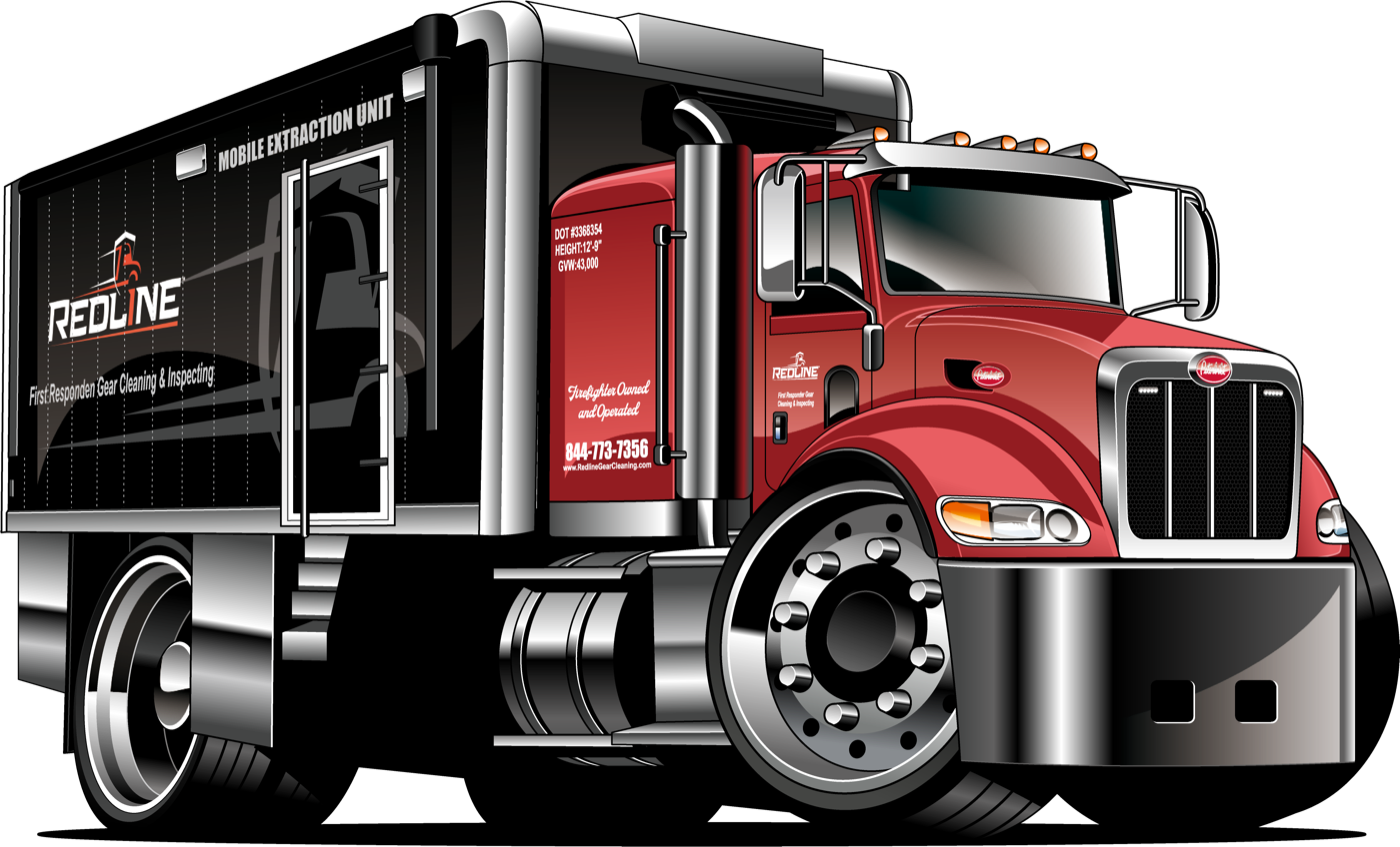
RedLine proposes a recurring, on-site mobile cleaning and inspection program for turnout gear and SCBA harnesses used at the Live Fire Training Facility. Service is performed at your location aboard RedLine’s self-contained Mobile Extraction Unit (MEU). Gear never leaves the site, and most sets are cleaned, dried, and back in rotation within hours.
Recurring & on-site
A scheduled program delivered at the Live Fire Training Facility aboard the MEU.
Turnout gear & SCBA
Cleaning and inspection of turnout gear, plus SCBA harness cleaning.
Back in rotation within hours
Most sets are cleaned, dried, and back in rotation within hours.
What it costs
Service & Pricing
| Service | Description | Unit cost |
|---|---|---|
| Advanced Cleaning – Full Turnout Set | Advanced cleaning of jacket, pants, and liners (per set) | $130.00 / set |
| Advanced Cleaning + Advanced Inspection – Full Turnout Set | Advanced cleaning plus full NFPA 1851 advanced inspection (per set) | $155.00 / set |
| SCBA Harness Cleaning | Advanced cleaning of SCBA harness (per unit) | $30.00 / unit |
| Additional Accessory Items | Helmet, hood, boots, or gloves beyond a 1:1 ratio with sets submitted | $5.00 / item |
Advanced inspection cost breakdown
Advanced inspection is $12.50 for the coat plus $12.50 for the pants, or $25.00 per set. Hydrotesting of moisture barriers is a separate charge.
| Advanced Cleaning – Full Turnout SetJacket, pants, and liners | $130.00 |
| + Advanced Inspection – Turnout CoatAdvanced inspection of jacket and liner | $12.50 |
| + Advanced Inspection – Turnout PantsAdvanced inspection of pants and liner | $12.50 |
| Advanced Cleaning + Advanced Inspection – Full Turnout Set | $155.00 / set |
| Hydrotesting of Moisture BarriersPriced separately per complete set. Not included in the $155.00 per-set price or in the estimates below. | $25.00 / set |
What’s included
- Every routine visit includes a basic visual inspection, with any needed repairs identified and documented at no additional charge.
- A full NFPA 1851 Advanced Inspection is performed once annually as part of the service schedule below.
- Accessory cleaning is included with each full set at no additional charge. The $5/item rate applies only to accessory items (helmet, hood, boots, gloves) submitted beyond a 1:1 ratio with full sets. For example, 15 hoods submitted against 10 full sets.
How often
Service Schedule Options
RedLine can support the Live Fire Training Facility on either a biweekly or monthly schedule. Gear used in live-fire training sees heavy, repeated contamination, so more frequent cleaning cycles keep gear fresher and reduce the time any set spends out of rotation; monthly service instead handles a larger volume in a single, less frequent visit. We’d like your input on which cadence best fits the facility’s training schedule and gear volume.
| Biweekly | Monthly | |
|---|---|---|
| Frequency | Every 2 weeks (26 visits/yr) | Once a month (12 visits/yr) |
| Sets per visit | 15–30 sets (SCBA matched 1:1) | 30–40 sets (SCBA matched 1:1) |
| Visit length | Single day | 2 days — crew stays overnight |
| Travel / mobilization fee | $300 / visit | $750 / visit |
| Standard visit cost | $2,700 – $5,100 | $5,550 – $7,150 |
| Annual advanced inspection visit | $3,075 – $5,850 per visit (both visits in the inspection month) | $6,300 – $8,150 (1 visit/yr) |
| Estimated monthly cost | $5,400 – $10,200 | $5,550 – $7,150 |
| Estimated annual cost | $70,950 – $134,100 | $67,350 – $86,800 |
Travel costs are calculated based on mileage to the training facility and, for service frequencies requiring a multi-day on-site visit, crew housing. Annual estimates reflect cumulative service across the full range of anticipated volume; actual monthly cost will vary based on training load.
How the annual estimate is calculated
- Each set requires a full advanced inspection once a year, so on biweekly service the advanced inspection is performed on both visits in the inspection month. A true biweekly cadence (every 2 weeks) runs 26 visits a year, so the annual estimate is 24 standard visits plus 2 advanced inspection visits.
- On monthly service, the annual advanced inspection is a single visit. The annual estimate is 11 standard visits plus 1 advanced inspection visit.
- These are estimates. Exact costs depend on the total number of sets that need advanced inspection on a regular basis, as well as training load.
A weekly service option isn’t available at this time. Should RedLine’s relationship with the department expand to support Los Angeles City Fire Department at large in the future, we could dedicate significant additional resources to this account, at which point weekly service would become a realistic option.
We don’t have a strong preference between biweekly and monthly service. Let us know which schedule works better for the Live Fire Training Facility, and we’ll build the program around it.
Try it first
Three-Month Trial Program
RedLine proposes a three-month trial to demonstrate the value of on-site service before committing to a long-term program. The department may choose either service frequency for the trial.
The department pays only for cleaning and inspection.
| Biweekly Trial | Monthly Trial | |
|---|---|---|
| Visits over 3 months | 6 visits | 3 visits |
| Sets per visit | 15–30 | 30–40 |
| Total sets cleaned | 90–180 | 90–120 |
| Estimated total trial cost | $14,400 – $28,800 | $14,400 – $19,200 |
At the conclusion of the trial, service transitions to standard pricing above, including the applicable travel/mobilization fee.
After the trial
Long-Term Program
Because the Live Fire Training Facility operates training year-round, the annual cost estimates in the Service Schedule Options above directly reflect what a full, ongoing program would cost. There is no separate reduced-season budget to plan around. Those figures can be used as the long-term benchmark for either service frequency.
Estimates only. Exact costs depend on training load and the total number of sets that need advanced inspection on a regular basis.
Keeping gear serviceable
Repairs
When repairs are identified during a basic inspection, RedLine notes the issue and confirms with the department’s point of contact before proceeding, flagging whether the concern is a safety issue or a cosmetic one so the department can prioritize and approve accordingly.
Identify & document
Any needed repairs are found during the basic inspection and documented at no additional charge.
Confirm with your point of contact
RedLine flags each item as a safety or cosmetic concern and gets approval before proceeding.
Repair & return
Repairs are completed off-site and returned per the standard visit schedule.
Biweekly service
Repaired items come back on the following scheduled visit.
Monthly service
Repaired items are shipped back to the department rather than waiting a full month.
Repair costs
Billed per RedLine’s standard repair rate sheet. For predictable, non-variable costs, RedLine can also discuss a flat per-set fee covering all repairs, upon request.
Mobile Repair Unit (MRU)
RedLine also operates a dedicated Mobile Repair Unit trailer. Given the added travel cost of deploying it, it is generally reserved for larger, consolidated repair engagements, for example a week-long annual on-site repair effort. It isn’t a natural fit for a regular biweekly or monthly visit model, but remains available as an option should the department’s needs grow.
Getting ready
On-Site Requirements
Site & logistics
- A flat, level outdoor area for the Mobile Extraction Unit (MEU) to park during the visit
- One apparatus bay (indoors preferred) for use as a staging / intake area
- Access to a water spigot; a standard garden hose connection is sufficient
- Access to a sanitary sewer drain (not storm drain) for wastewater. All water is treated onboard the MEU before discharge
- No electrical/power connection required; the MEU operates on its own onboard generator
Gear & crew preparation
- A roster or shift schedule identifying whose gear is being cleaned
- Members should empty pockets and remove helmet bands, cameras, flashlights, and tools before gear is turned over
- Gear should be kept together by firefighter: 1 helmet, 1 hood, 1 pair gloves, 1 jacket, 1 pants, 1 pair boots
- Gear dropped off individually should be bagged with the firefighter’s name attached
Proof of compliance
Documentation & Reporting
Every set cleaned and inspected is documented for NFPA 1851 compliance. Beyond the static reports, the department gets its own customer portal login, an always-on view into the state of every piece of gear in the program.
Your Own Customer Portal
Real-time access to the cleaning history of all your gear, so your team always has the relevant details on your PPE at your fingertips.
- Cleaning history for every set, updated as visits happen
- Inspection results and repair records, in one place
- On-demand visibility across all gear in the program, any time
PDF reports
NFPA 1851 documentation for every set cleaned and inspected.
Excel reports
The same documentation provided in Excel format.
This is what sets RedLine apart: we’re not just a cleaning company. With real-time reporting and a dedicated customer portal, we’re a true partner in PPE management and compliance.
Questions about this proposal